Nine ministries remain vacant in al-Zaidi’s government. Is a ministerial share for the Turkmen community even on the negotiating table?
Nine portfolios remain vacant: will the next vote include a share for the Turkmen community? By Hussein Zain al-Abidin | Independent researcher — Minority rights in Iraq | husseinmonitor.com Nearly three months after Iraq’s Council of Representatives granted partial confidence to…
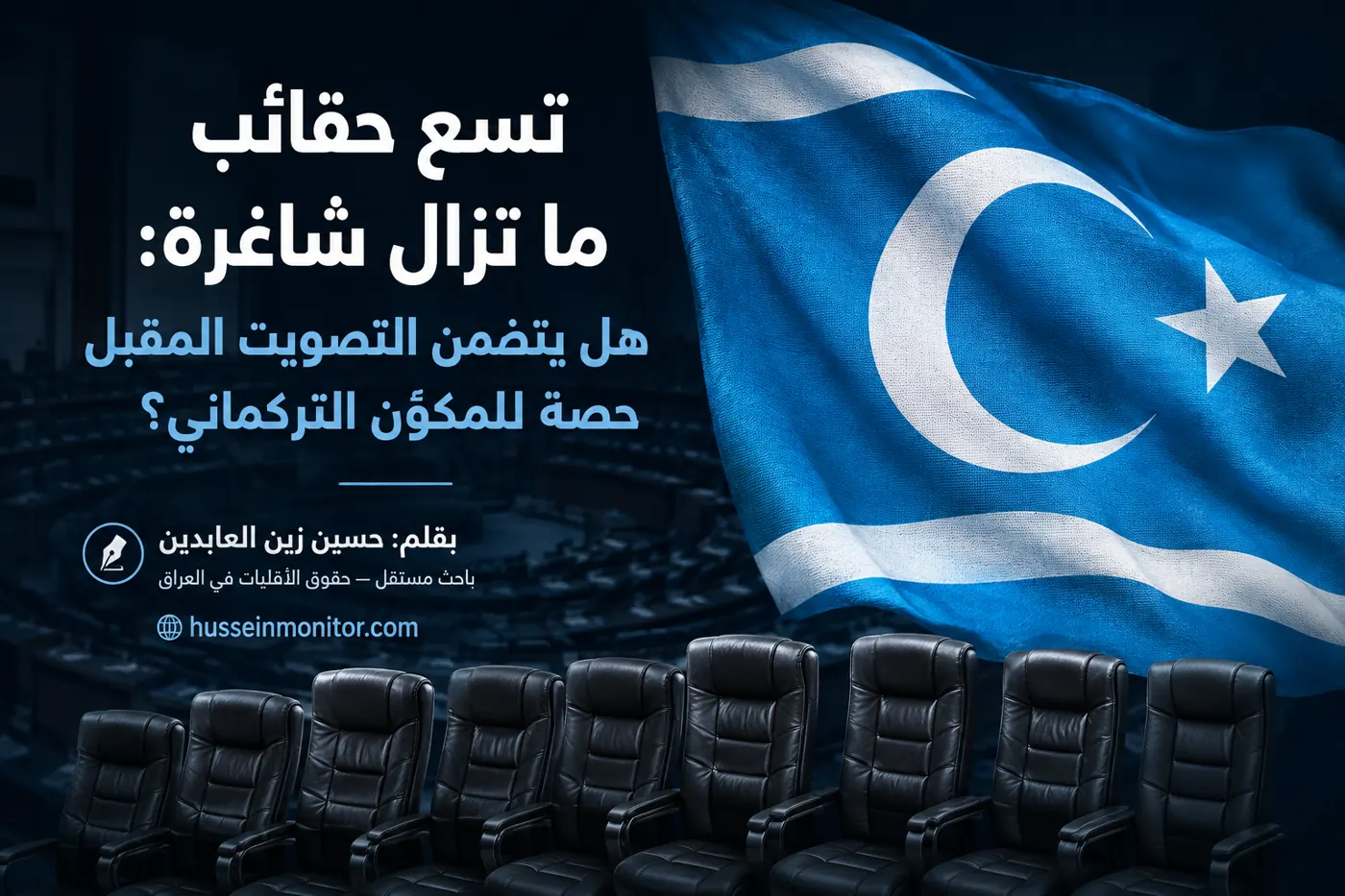

Nine portfolios remain vacant: will the next vote include a share for the Turkmen community?
By Hussein Zain al-Abidin | Independent researcher — Minority rights in Iraq | husseinmonitor.com
Nearly three months after Iraq’s Council of Representatives granted partial confidence to the government of Prime Minister Ali Falih al-Zaidi, nine ministries remain vacant, awaiting a resolution. As a second voting session approaches, a question returns to the fore that three successive governments have answered in the same way: will the country’s third-largest community get a seat at the cabinet table, or will it once again have to settle for words of appreciation?
The issue goes beyond symbolism. In the Iraqi system, a ministry is not an honorary distinction: it means a budget allocation, hiring authority, a channel for reconstruction contracts, and a seat in the room where decisions concerning Kirkuk, Tal Afar, Tuz Khurmatu, and missing persons are actually made.
Where things actually stand
On May 14, 2026, the Council of Representatives voted to grant confidence to fourteen of twenty-three ministers and approved the government program, while voting on nine portfolios was postponed because of disagreements between blocs. The deferred portfolios are: Interior; Defense; Planning; Higher Education and Scientific Research; Construction, Housing and Municipalities; Culture, Tourism and Antiquities; Labor and Social Affairs; Youth and Sports; and Migration and Displacement.
Successive deadlines for completing the cabinet have passed without being met — first mid-July, then before the prime minister’s visit to Washington. Attention has now shifted to September, a month already burdened by the issues of bringing arms under state control and the final withdrawal of coalition forces. One option under consideration is to approve the remaining ministries as a single package rather than submit each portfolio separately, reducing the parties’ ability to use each ministry as a separate bargaining chip.
None of the nine vacant portfolios has been publicly designated as the Turkmen community’s entitlement.
What the Turkmen bloc says
In late May 2026, Arshad al-Salihi, head of the Iraqi Turkmen Front, stated that the Turkmen had expected to receive a ministry in al-Zaidi’s government, but that this had not happened. Since then, he has pressed two specific demands: the position of vice president, which he describes as a previous Turkmen entitlement that must not be reserved exclusively for Sunnis and Shiites; and the position of minister of state for foreign affairs, a ministry whose creation the Front had previously proposed to the former prime minister.
He also raised the prospect of turning to the international community if this entitlement was not fairly addressed domestically. There are few practical tools behind that warning, but it is a signal worth examining: a community that has spent two decades within the political process has begun describing that process as closed to it.
As for the proposal to restructure the vice presidency into three positions — Shiite, Sunni, and Turkmen — reports in May indicated that it had support within the parliamentary leadership, but it has not been put to a vote. A distinction matters here: the vice presidency is a ceremonial position with limited executive impact, not a substitute for a ministerial portfolio.
From continuous presence to complete absence
The record is short enough to set out clearly, and it reveals decline rather than continuity:
- 2005–2014: Jasim Mohammed Jaafar al-Bayati, a Turkmen born in Tuz Khurmatu and deputy secretary of the Islamic Union of Iraqi Turkmen, served as minister of construction and housing in the Iraqi Transitional Government, then took over the Ministry of Youth and Sports in May 2006, remaining in office through Nouri al-Maliki’s first and second governments. The community thus maintained an uninterrupted ministerial presence for nearly nine years.
- 2014–2015: Mohammed Mahdi al-Bayati, a Shiite Turkmen and leader in the Badr Organization, headed the Ministry of Human Rights — a position secured through his party, not through a Turkmen ethnic entitlement.
- 2020: The Council of Representatives authorized Mustafa al-Kadhimi’s government to create a ministry of state specifically to ensure Turkmen representation, and in December 2020 voted to grant confidence to Hiyam Nemat Mahmoud al-Haidari as minister of state — described at the time as the first Turkmen portfolio in years.
- 2022–2026: Mohammed Shia al-Sudani’s government did not include a single Turkmen minister, which Turkmen circles regarded as a precedent — complete elimination, not merely a reduction.
- 2026: None of the fourteen ministers approved in al-Zaidi’s government holds a portfolio allocated as a Turkmen entitlement, and nine portfolios remain, not one of them designated for the community.
A recurring argument holds that a Turkmen already occupies a senior security portfolio, and that the entitlement has therefore been fulfilled. Turkmen political bodies reject this argument, and the reasoning is sound: a minister who reaches office through the quota of a Sunni Arab alliance represents that alliance in the room, not the community to which he belongs by ancestry. Ethnic identity is not political representation. The United Iraqi Turkmen Front list has consistently framed its demand as an ethnic entitlement on a par with those of other communities.
The comparison that should not be ignored
One of the nine vacant portfolios reveals the heart of the problem with particular clarity. The Ministry of Migration and Displacement is stalled by a dispute over the Christian community’s political representation, with competition between the Babylon bloc and the Shwayana bloc, and disagreement among political forces over who has the right to nominate the minister.
Consider what this means procedurally: for the Christian community, the question of “who holds the entitlement” is on the negotiating table and is actually delaying a voting session. For the Turkmen, no such question is being negotiated at all, because no portfolio was allocated to the community in the first place. Christian representation is contested; Turkmen representation is absent. Being the subject of a dispute is a form of political existence; not being mentioned is not.
This is not a call to diminish anyone’s share. It is an observation about how entitlements enter the bargaining process in Baghdad — and about which communities have a bloc large enough, or backing strong enough, to force their issue onto the agenda.
The structural problem behind the numbers
Weak Turkmen representation in the executive is not an incidental outcome of a particular negotiation, but the arithmetic consequence of a system built around three recognized political camps. Following the November 2025 elections, Turkmen parliamentary representation stands at roughly five seats out of 329, won in Kirkuk, Mosul, and Baghdad, alongside a guaranteed minority-quota seat. In a system where ministerial shares are traded for parliamentary weight within the Shiite, Sunni, and Kurdish camps, a bloc of this size has no independent bargaining power. It is invited to sign the government program, not to draft it.
The Kurdistan Region offers a partial comparison worth noting: Aydin Maruf serves as the minister responsible for ethnic and religious communities in the regional government, and Turkmen representatives there have previously publicly demanded more than one portfolio. Whatever the limitations of this arrangement, the federal government has no comparable permanent mechanism at all.
What genuine inclusion means
If the next vote is to be more than a redistribution among the same three camps, the minimum credible steps are:
- Allocate one of the nine remaining portfolios as a Turkmen entitlement — explicitly identified as such in the allocation agreement, rather than filled by a Turkmen figure drawn from another bloc’s share. A service-delivery or reconstruction ministry directly relevant to Kirkuk, Tal Afar, and Tuz Khurmatu would carry real weight.
- Resolve the vice-presidency proposal through a vote, not postponement — either restructure the office to include a Turkmen vice president, or state clearly that this will not happen, rather than leave the community negotiating against an indefinite “maybe.”
- Distinguish ethnic identity from political entitlement in the public record — with the government specifying which ministries were allocated as community entitlements and which as party shares, so that a minister’s ancestry is not presented as a substitute for representation.
- Establish a permanent federal mechanism for community representation — parallel in function to the regional model, so that matters concerning Turkmen, Christians, Shabak, Yazidis, and Kaka’is are not renegotiated from scratch with every new government.
- Link representation to unresolved issues, not ceremonies — missing persons from Tal Afar, the return of displaced people, administration of disputed territories, and women survivors’ access to reparations under the Yazidi Survivors Law are all issues on which the absence of Turkmen from the executive has a measurable impact.
Conclusion
There is still time for the answer to change. Nine portfolios remain vacant, bargaining has not yet closed, and September will force decisions that August was able to postpone. A single ministry, publicly designated as a Turkmen entitlement, would cost the governing coalition very little and bring an end to a grievance that has accumulated across three governments.
But if the nine seats are distributed among the same three camps, and the community is once again asked to sign off on the result, the message will be unmistakable — and it will not be a message about arithmetic and numbers, but about who is considered a partner in the Iraqi state and who is considered a guest.
A community thanked in every speech but named in no cabinet has not been included — it has been managed.
Sources:
- Erem News — “Nine portfolios fuel disputes: can al-Zaidi break Iraq’s political deadlock?” — August 2026
- Ultra Iraq — “Turkmen bloc threatens to turn to the international community: we did not receive a ministry in al-Zaidi’s government” — May 25, 2026
- Al Jazeera Net — “Decision on nine portfolios postponed: Iraqi parliament grants partial confidence to al-Zaidi’s government” — May 15, 2026
- Al-Quds al-Arabi — Report on the proposal for three vice presidents, including a Turkmen — May 2026
- Arabi Post — “Details of the struggle over ministerial portfolios in the new Iraqi government” — June 30, 2026
- Anadolu Agency — “Iraq: Turkmen receive their first ministerial portfolio in years” — December 2020
- Anadolu Agency — “Iraq: Turkmen demand more than one portfolio in the Kurdistan Regional Government” — December 2024
- ORSAM Center — Analysis of Turkmen representation and the 2020 ministry-of-state arrangement
- Kitabat — “Turkmen in Iraq: when the door to power is closed to the third-largest community”
- Al-Alam — “A partner, but… how do Turkmen view their exclusion from government representation?”
- Independent High Electoral Commission — Parliamentary election results, November 2025
Independent research and analysis
Hussein Monitor
A platform publishing in-depth field research on minority rights in Iraq, accountability after ISIS, and the human cost of impunity. By Hussein Zain al-Abidin — former liaison officer with the United Nations Assistance Mission for Iraq and independent researcher.
→ Visit Hussein Monitor Subscribe on Substack