Incomplete Justice: How Are Turkmen Child Survivors of ISIS Being Denied Their Rights for the Third Time?
Incomplete Justice: Why Do Turkmen Child Survivors of ISIS Remain Outside the Survivors Law? By Hussein Zain al-Abidin | Independent Researcher — Minority Rights in Iraq | husseinmonitor.com Yazidi MP Khalid Sido announced today, Saturday, 22 …

Incomplete Justice: Why Do Turkmen Child Survivors of ISIS Remain Outside the Survivors Law?
By Hussein Zain al-Abidin | Independent Researcher — Minority Rights in Iraq | husseinmonitor.com
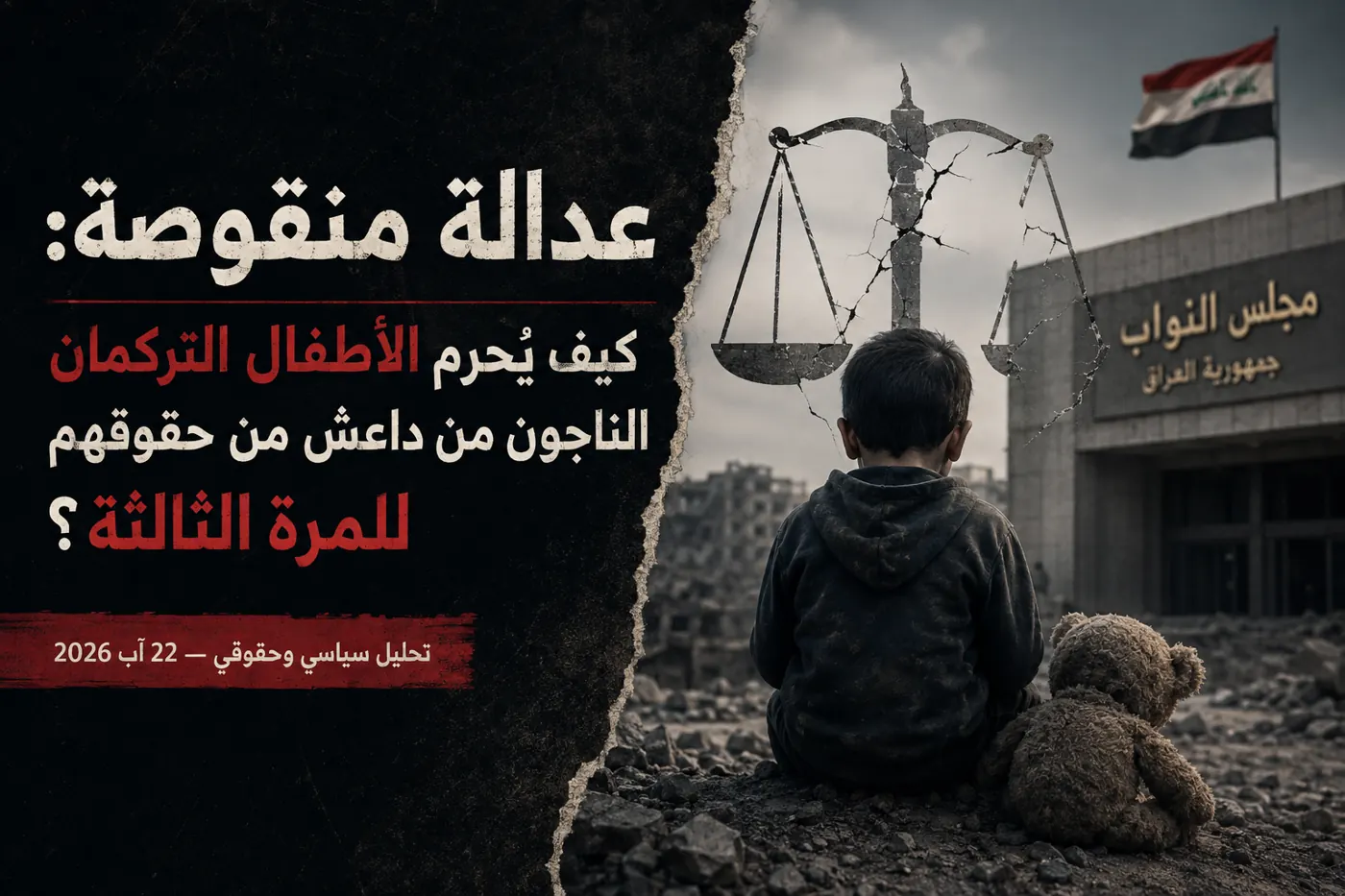
Yazidi MP Khalid Sido announced today, Saturday, 22 August 2026, that the draft amendment to the Yazidi Survivors Law had been withdrawn from the draft agenda of the Iraqi Council of Representatives session scheduled for tomorrow, Sunday, according to the Lalish Media Network. The amendment, intended to explicitly establish the inclusion of Turkmen, Christian, and Shabak child survivors under the law, has repeatedly stalled since 2023 without ever reaching a vote.
First: The Original Law and Its Gap
When the Iraqi Council of Representatives passed the Yazidi Survivors Law on 1 March 2021, it marked an important achievement, granting women survivors of genocide and sexual violence committed by ISIS financial and non-material rights: a pension, a residential plot of land, priority in employment, and educational exemptions. The law's text was not limited to Yazidis; it also covered survivors from the Turkmen, Christian, and Shabak communities.
Article One/First of the draft first amendment to this law, prepared by the Presidency of the Republic, provides for expanding the definition of a "female survivor" to include any woman or girl subjected to sexual violence, abduction, enslavement, forced marriage, or displacement by ISIS since 10 June 2014, regardless of her community. Article Two/Third of the draft states explicitly that "child survivors (Yazidis, Turkmen, Christians, and Shabak) are those who were under eighteen years of age when abducted" — meaning that the proposed text names all four communities explicitly and equally. This is precisely the provision whose adoption has faced repeated objections.
Second: Repeated Setbacks
This is not the amendment's first setback. Iraqi press coverage has documented at least three major episodes since 2023: in 2023, the Presidency of the Republic referred the draft amendment to the Council of Representatives, but it was never placed on the agenda, amid public Yazidi opposition that activists at the time described as an "injustice," according to KirkukNow. In February 2025, the chair of the parliamentary Human Rights Committee, Arshad al-Salihi, revealed that a similar amendment had been proposed to include Turkmen survivors under the age of 18, warning that "political interests" were blocking a vote, according to Alsumaria News. On 22 August 2026, MP Khalid Sido announced the amendment's withdrawal from the draft agenda of the scheduled Sunday session, following intervention by several Yazidi MPs who stressed, according to the Lalish Media Network, that they would not allow a vote on any amendment without their prior approval.
Third: The Human Cost of Repeated Delays
Behind this political and procedural debate are real numbers and names. These are children who experienced abduction, displacement, and loss under ISIS control of areas of Tal Afar, Sinjar, and Nineveh between 2014 and 2017, sharing the same fate as Yazidis. Yet today they are left without redress because of a political dispute unrelated to their actual suffering.
Fourth: Who Bears Responsibility?
Turkmen voices that supported the Survivors Law from its initial passage and shared the concerns of their Yazidi brothers and sisters for years now face a bitter paradox: their support for the law has not been met with equivalent fairness when it comes to their own children. What is needed is not to take rights away from Yazidis, but to broaden the umbrella of justice to include everyone who suffered the same crime, at the same time, at the hands of the same perpetrator.
Conclusion
From 2023 to the present, the amendment to the Survivors Law has stalled in successive documented episodes. Each time, dozens of Turkmen, Christian, and Shabak children and women remain outside the scope of the legal redress they deserve. Transitional justice cannot accommodate selectivity based on community identity, and all victims of ISIS, without exception, deserve recognition, compensation, and dignified reintegration into their communities.
The question remains: how long will these children's suffering be held hostage to political calculations unrelated to their tragedy?
Sources:
- Text of the draft first amendment to the Yazidi Survivors Law No. 8 of 2021 (official document)
- Lalish Media Network — Statement by MP Khalid Sido, 22 August 2026
- Alsumaria News — Statement by parliamentary Human Rights Committee chair Arshad al-Salihi, February 2025
- KirkukNow — Yazidi opposition to the amendment, 2023
- Post by Dr. Mahdi Saadoun on X, 22 August 2026
- Turkmen Rescue Foundation (TRF)
Hussein Monitor
INDEPENDENT RESEARCH & ANALYSIS
A platform publishing in-depth field research on minority rights in Iraq, accountability after ISIS, and the human cost of impunity. Written by Hussein Zain al-Abidin — former liaison officer with the United Nations Assistance Mission for Iraq and independent researcher.
→ Visit Hussein Monitor Subscribe on Substack