The Cost of Political Representation in Iraq
The Cost of Political Representation in Iraq: Examining the Gap Between Parliament and Provincial Councils By Hussein Zain al-Abidin | Independent Researcher — Minority Rights in Iraq | husseinmonitor.com Amid the continuing liquidity crisis facing the Iraqi state…
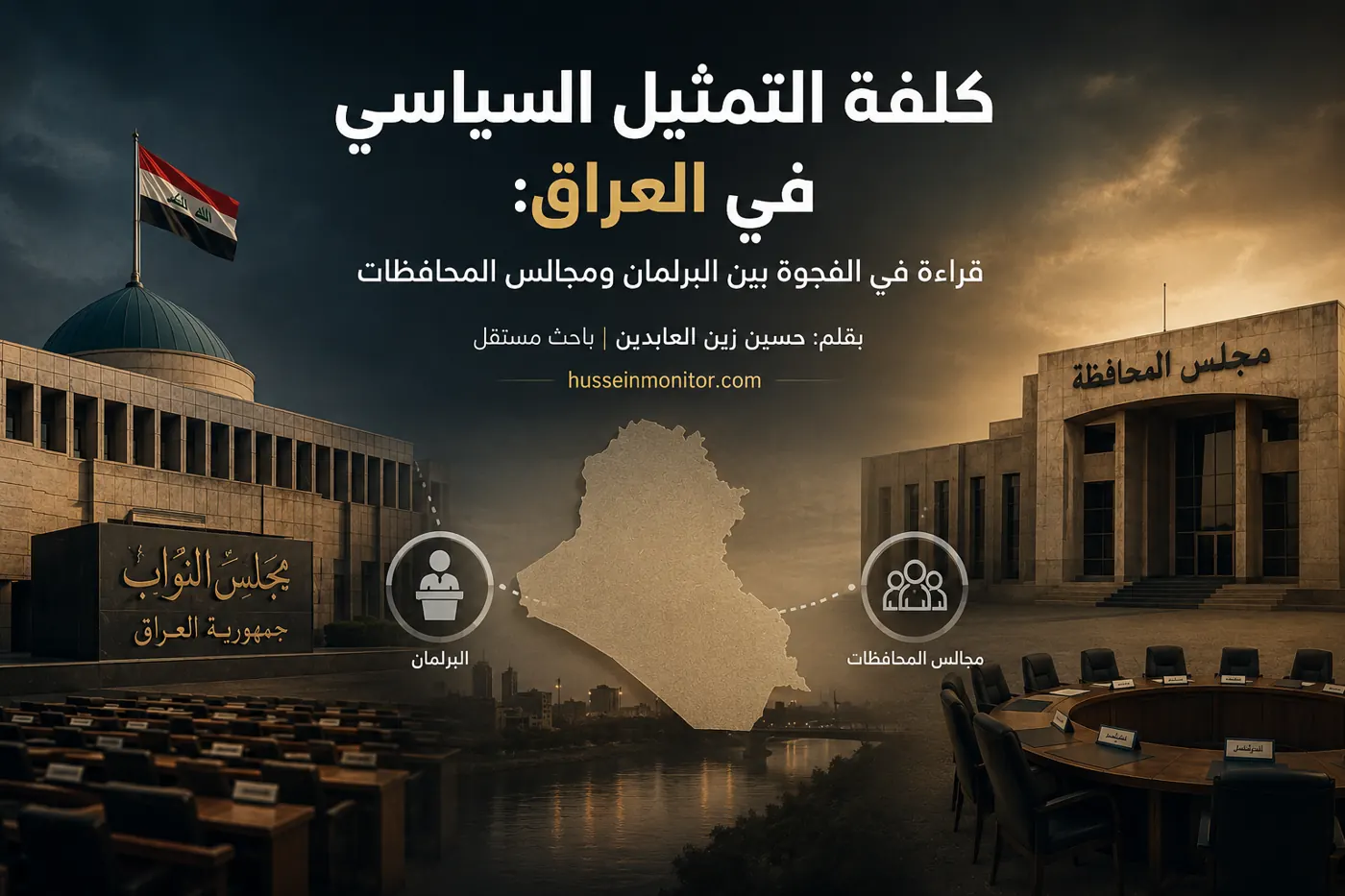

The Cost of Political Representation in Iraq: Examining the Gap Between Parliament and Provincial Councils
By Hussein Zain al-Abidin | Independent Researcher — Minority Rights in Iraq | husseinmonitor.com
Amid the continuing liquidity crisis facing the Iraqi state and delays in paying employees at several government institutions, questions periodically resurface about the cost of representative institutions, both parliamentary and local, and whether maintaining this level of spending on them is justified under current economic conditions.
This report reviews figures cited in press reports and partial official sources regarding the cost of parliamentary and local council membership. These figures vary by source, year, and method of calculation, given the absence of regular, detailed official disclosures by the relevant authorities.
First: The Cost of a Member of Parliament
Reported estimates of an Iraqi member of parliament’s salary vary considerably depending on the source and the date of the statement. Relatively recent statements by MPs indicated that an MP’s basic salary had risen from around 7.5 million dinars to more than 8 million dinars per month. Other reports, however, indicate that the basic salary rises to between 10 and 25 million dinars once allowances for office, special and exceptional allowances, and transport and hospitality allowances are included, depending on the MP’s educational qualifications and according to statements by former MPs.
These reports also indicate that each MP receives allowances for up to 16 personal security personnel, while the speaker of parliament and the two deputy speakers each receive a salary of around 35 million dinars per month, on a par with the president and the prime minister.
As for the overall cost, published data on parliament’s 2021 budget indicate that its annual expenditure amounted to approximately 496 billion dinars. This means that the total cost per MP — including salaries, allowances, security personnel, staff, and operating expenses — approaches 1.5 billion dinars annually, or around 125 million dinars per month, when divided among the 329 MPs. This figure is far higher than the basic salary alone because it includes the entire administrative and service apparatus supporting parliament’s work, not just the MP’s salary.
Second: The Cost of a Provincial Council Member
By comparison, reported estimates put a provincial council member’s salary at around 2.7 million dinars per month as a fixed, all-inclusive payment — far below an MP’s basic salary. Nor does it include additional security allowances at the same level: protection for a provincial council member is usually limited to a small number of Interior Ministry personnel, without additional financial allowances comparable to those received by an MP.
Provincial councils have approximately 274 members, excluding the Kurdistan Region, distributed across the councils of the remaining fifteen provinces following their reactivation in recent electoral cycles.
Third: The Broader Political Context
This debate over the cost of elected institutions comes at a time when various political analyses suggest that many of Iraq’s most consequential decisions are not necessarily made in parliament, but through negotiating frameworks among the leaders of the main political blocs that are not provided for in the constitution. The most prominent of these is known in the media as the “State Administration Coalition,” which includes the holders of the state’s three highest offices and leaders of political blocs and movements, and holds regular meetings to discuss contentious issues and the allocation of posts.
Researchers on Iraqi politics argue that this approach to governance through consensus agreements and quota-based power-sharing, although not explicitly provided for in the constitution, has become an entrenched political convention since 2005. It has turned government formation into a negotiation among bloc leaders rather than a competition between political platforms, prompting observers to question the extent to which parliament independently exercises its actual legislative and oversight functions.
Fourth: Contrasting Views on Rationalizing Expenditure
Against this backdrop, efforts have emerged within parliament itself in recent months to examine the salaries of the holders of the state’s highest offices and senior officials, with the aim of restructuring the pay scale and achieving greater balance with other employees’ salaries. These efforts coincide with continuing financial pressures and delays in salary payments at some government institutions.
Supporters of reducing legislative expenditure argue that rationalizing MPs’ salaries and allowances could free up funds for basic services and overdue salaries. Others, however, warn that any disruption to the work of legislative institutions, even partial or temporary, could weaken the remaining mechanisms for oversight of the executive and the public budget, particularly in the absence of clear institutional alternatives to ensure transparency and accountability.
Conclusion
The gap between the cost of parliamentary and local council membership in Iraq remains a subject deserving more precise and transparent official scrutiny, beyond the conflicting estimates circulating in the media.
The central question remains before the public: Does the solution lie in reducing the size and cost of representative institutions, or in reforming how they operate and effectively anchoring them in their constitutional roles of legislation and oversight, rather than allowing them to become an additional financial burden on a state already suffering from a liquidity shortage?
Sources:
- Shafaq News — “Some Government Officials Earn More: Details of an Iraqi MP’s Salary Revealed”
- Al-Saa News Agency — Statements by MP Mansour al-Mur‘id on the salary of a member of parliament
- Jummar — “The Billion-Dinar Costs of MPs: How Did the Cost of an MP to Iraqis Rise by 50 Percent?” — February 2025
- Al Jazeera Net — “Discontent in Iraq over Possible Increase in MPs’ Salaries” — August 2024
- Independent Press Agency — “Salaries of the Holders of the State’s Highest Offices on Parliament’s Agenda: A Move to Cut Pay”
- Iraqi Council of Representatives — Financial Department, mechanism for disbursing members’ entitlements
Hussein Monitor
INDEPENDENT RESEARCH & ANALYSIS
A platform publishing in-depth field research on minority rights in Iraq, accountability after ISIS, and the human cost of impunity. By Hussein Zain al-Abidin — former liaison officer with the United Nations Assistance Mission for Iraq and independent researcher.
→ Visit Hussein Monitor Subscribe on Substack