The Dinar, Trust, and Power: Do Dollar Pressures Signal Political Change in Iraq?
Exchange-rate pressures in Iraq evoke memories of the dinar’s collapse during the 1990s, but differences in the structure of the economy and political power mean the comparison requires scrutiny. The political danger lies not in the dollar’s rise alone, but in its becoming one link in a crisis of livelihoods, justice, and trust in institutions.
When the Dollar Exchange Rate Becomes a Question of Political Legitimacy
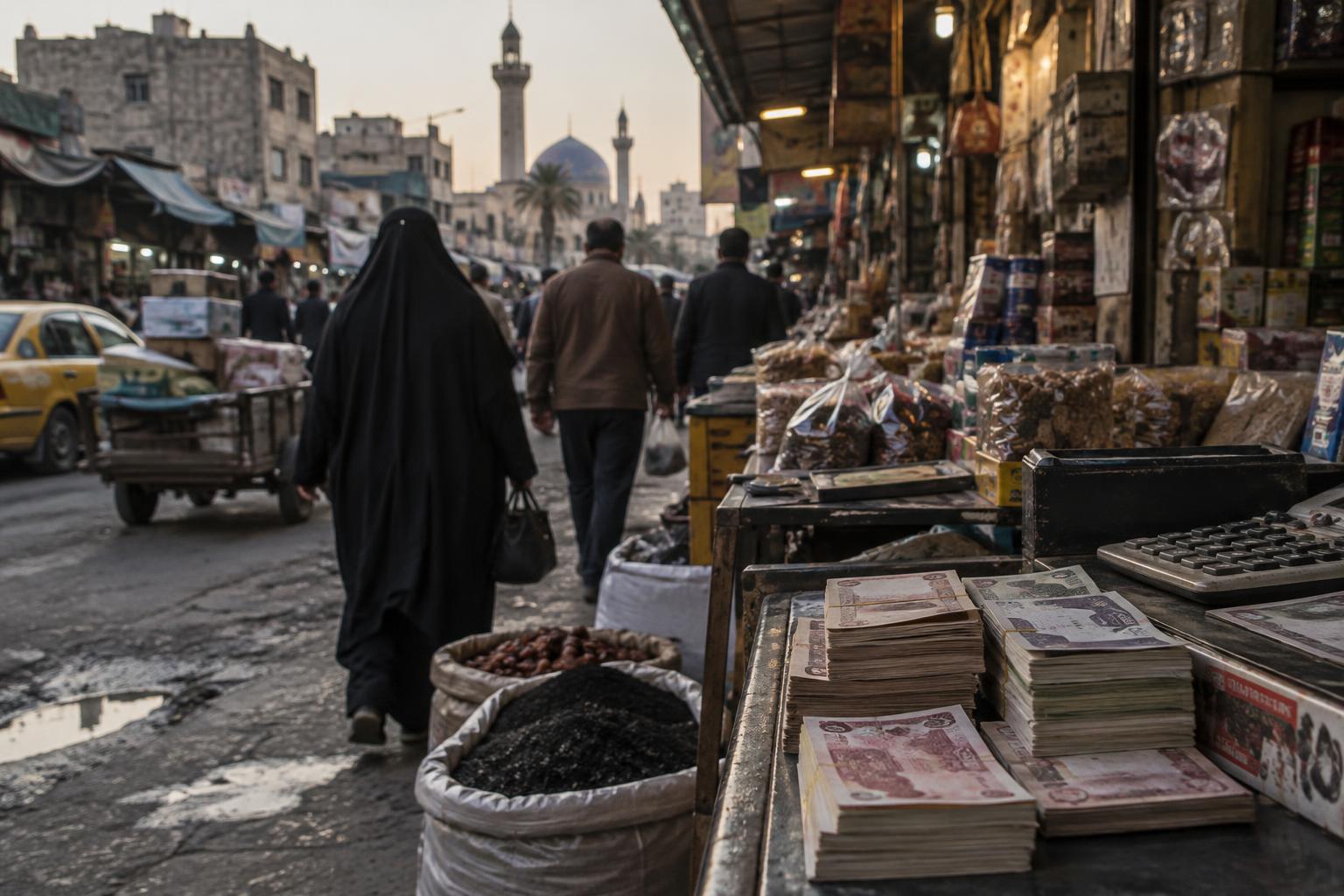
In Iraq, the dollar exchange rate is not viewed merely as a financial indicator. It factors into the costs of food, medicine, housing, and trade, and evokes memories of a period when savings, salaries, and the state’s ability to fulfill its promises were eroded. It therefore seems legitimate to ask whether current exchange-rate pressures point to a manageable economic crisis or to a deeper trajectory of declining trust that could reshape the political class.
But answering this requires distinguishing among three things: currency depreciation, declining purchasing power, and the prospect of political change. These phenomena may interact, but they are not synonymous. A rising dollar does not topple a government on its own; it may become a significant political factor when it exposes institutional failure, distributes losses unfairly, and closes off people’s prospects for improvement.
What Happened to the Dinar Under Saddam?
The dinar’s dramatic collapse, particularly during the 1990s, was linked to the cumulative effects of wars, international sanctions, damage to the productive base, and restrictions on foreign revenues. As resources dwindled and the state resorted to monetary financing, the currency lost value and prices rose, while government wages lost much of their ability to cover living expenses.
This was not merely a monetary crisis, but a crisis of state and society. Families resorted to selling possessions or seeking additional work, services deteriorated, and inequalities widened between people on fixed incomes and those able to access foreign currencies or networks of trade and influence. Nor was the monetary experience entirely uniform across Iraq’s regions, making historical generalizations a matter requiring caution.
Nevertheless, it is incorrect to say that the dinar’s collapse brought down Saddam Hussein’s regime. The regime survived for years after the economic shock, relying on repression, control, and the distribution of resources to circles of loyalists. His rule ended with the US-led invasion in 2003, not with a monetary collapse that automatically became a political transition. The lesson here is that impoverishing society may weaken a government’s legitimacy without eliminating its ability to survive.
Why Is the Current Crisis Different?
Iraq today is not an economy operating under the same conditions it experienced in the 1990s. It exports oil, receives revenues in dollars, and possesses foreign reserves, monetary institutions, and international banking and trade links. These elements give it tools to absorb shocks, although they do not eliminate the fragility arising from its heavy dependence on oil, imports, and public spending.
The structure of political power is also different. Instead of a single-person center of rule, there is a system of multiple parties and centers of influence, encompassing elected institutions, power-sharing networks, economic interests, and armed groups. This multiplicity creates opportunities for negotiation and adjustment, but it can also diffuse responsibility: parties participating in government can present themselves as opponents of its outcomes.
For this reason, a superficial comparison between a high dollar exchange rate in the past and a high rate today is insufficient. The more precise question is: what is the source of the pressure, how capable is the state of managing it, and who bears its cost? Every surge should also not be described as the beginning of a comprehensive collapse without considering its duration, scale, and impact on prices, production, and reserves.
The Gap Between the Official Rate and the Parallel Market
One of the essential keys to understanding Iraq’s situation is distinguishing between the official dollar exchange rate and its rate on the parallel market. The gap between them may widen even without an official change in the dinar’s value when some commercial or financial demand cannot be met through approved banking channels.
Compliance requirements, anti-money-laundering measures, and scrutiny of foreign transfers affect how banks and traders obtain dollars. These requirements are necessary to protect the financial system, but implementing them requires institutional capacity and practical channels for legitimate trade. When procedures are complicated or unclear, transactions may move to the parallel market. Informal demand, currency smuggling, and speculation can also increase pressure, without being the sole explanation for every rise.
Dollar fluctuations do not feed through to goods to the same extent or at the same speed. Some traders may set prices according to actual import costs, while others use anticipated replacement costs or a hedging margin. Oversight therefore requires data on supply chains and competition, rather than sweeping accusations or punitive measures that obscure the causes of the dysfunction.
Who Bears the Burden of Declining Purchasing Power?
The heaviest burden usually falls on people with fixed incomes, irregular workers, and families that devote most of their spending to necessities. Groups holding assets or earning income in dollars may be able to protect part of their wealth, while the savings of those without hedging tools erode. Here, a monetary issue becomes a question of fairness in the distribution of losses.
Displaced families and those returning to conflict-affected areas face additional pressures, particularly when high prices coincide with limited job opportunities, missing documents, or difficulties accessing services. In Yazidi, Christian, and Turkmen communities affected by violence and displacement, rising costs may delay home repairs and the restoration of businesses. This does not stem from identity alone, but from accumulated deprivation, inadequate protection, and geographic disparities.
When Do Economic Pressures Turn into Political Change?
The exchange rate becomes more politically dangerous when it combines with unemployment, faltering services, corruption, and a sense that institutions protect the powerful more than they protect citizens. The Tishreen protests of 2019 demonstrated that dissent in Iraq can move beyond demands for services to questioning the rules of governance, representation, and accountability.
But anger alone does not determine the outcome. Change also depends on the existence of credible organizations and alternatives, a safe space for protest, electoral and judicial institutions capable of fulfilling their roles, and divisions within the elites. In the absence of these conditions, the crisis may lead to a limited cabinet reshuffle, a redistribution of influence, or greater repression, rather than a democratic transformation.
A set of indicators should therefore be monitored together: the persistence of the gap between the two exchange rates, the erosion of real wages, the capacity of public finances to meet obligations, poverty and employment trends, and citizens’ trust in banks and institutions. Most important is whether the authorities acknowledge the problem and allow independent accountability for its causes and costs.
Trust Is Built Through Policy, Not Slogans
Containing the crisis requires facilitating formal financing for legitimate trade, publishing understandable monetary information, combating smuggling and corruption in accordance with the law, and protecting the most vulnerable groups from price shocks. In the longer term, the dinar’s stability cannot be separated from diversifying production, reducing dependence on oil, and reforming public spending.
Iraq is not destined to repeat the 1990s, nor is there an inevitable relationship between a rising dollar and the end of the ruling class. But dismissing the comparison entirely misses its most important warning: when income losses turn into a conviction that the state is incapable or biased, a currency crisis becomes a crisis of legitimacy. What determines the trajectory is not the exchange rate alone, but institutions’ ability to correct dysfunction fairly and convince society that reform is possible without another shock.